

Abbey Place - HUB Group
Abbey Wood is a landmark new development of apartments, commercial space and public realm in the London Borough of Greenwich.

Appleby Blue Almshouse
A modern Almshouse for a more connected community.
Older persons’ social housing initiative comprising of 57 extra-care homes with shared facilities like a cookery school kitchen, communal dining spaces, meeting rooms, craft areas, and communal gardens with raised beds for allotment style food production. 2025 Stirling Prize Winner.
Appleby Blue, founded and overseen by the United St Saviour’s Charity in Southwark, is a modern almshouse, a testament to community-focused architecture. Its design targeted a 35% reduction in carbon emissions compared to 2013 Building Regulations.
The building’s fabric was optimised for thermal performance. The layout centres on a communal courtyard garden. Facing the busy A2206, a five-storey northern block houses communal and shared spaces. This positioning makes them visible and easily accessible to the broader community, while also forming a visual and acoustic shield for the garden. A lower two-storey southern block ensures year-round sunlight for the garden and main block. South-facing façades maximise daylight with solar shading to prevent overheating, and thermal mass for passive cooling in warmer weather and at night, helping regulate indoor temperatures.
The building promotes natural ventilation. Double-height communal areas enhance cross-flow, while glazed corridors function as tempered winter gardens, opening in summer to form comfortable spaces to sit and chat.
Below ground, heating, water, and electrical systems run along corridor routes into each flat, with central plantrooms supplying water and heating to local heat interface units for added efficiency. Ventilation is provided by partially centralised roof extract fans serving clusters of flats with automatically controlled airflow. Communal areas feature smart lighting responsive to occupancy and daylight. The building also includes infrastructure for a telecare nurse call system and dual integrated fire systems for residential and commercial zones. Originally designed with CHP, the project evolved over 10 years, transitioning to PV panels that would account for 20% of the building’s carbon reduction through renewable energy.
Appleby Blue reflects a decade-long commitment to sustainable living and community connection, creating a nurturing setting where residents can age gracefully and remain integral to their community.
Awards
2025 RIBA Stirling Prize Winner
2025 RIBA Neave Brown Award for Housing - Winner
2025 RIBA Client of the Year Winner
2025 RIBA National Award Winner
2025 RIBA London Award Winner
2025 Pineapples Award Healthy Homes - Winner
2024 Housing Design Award - Winners of Winners
“We are honoured to receive the RIBA Client of the Year Award for Appleby Blue Almshouse. This project embodies our ambition to support inclusive communities in Southwark through thoughtful, innovative design, and our belief that good design should be available to all. Working closely with Witherford Watson Mann, we’ve shown that historic organisations can be bold and forward-thinking, and that social housing can and should be well-designed and A aspirational.
The building’s design enables joyful living in the heart of the city, supports our team to deliver high-quality services, and fosters belonging across generations through the shared community centre and kitchen. This award is down to the strength and belief in of our shared vision, our very close working relationship with the architects, as well as our joint long-term commitment to the design principles that shaped every decision. We hope Appleby Blue inspires others to reimagine what growing older in our cities can look like — and to create more places like it across the country.”
Martyn Craddock, Chief Executive, United St Saviour’s Charity

Chadwick Hall Student Accommodation (Downshire House)
A series of new student accommodation buildings at the University of Roehampton, also known as Chadwick Hall. Skelly & Couch was appointed to carry out full mechanical, electrical, public health and environmental services for the University of Roehampton on this design and build.

Gascoigne East Estate
Skelly & Couch was appointed for Phase 2 of the ongoing renewal of the Gascoigne East estate in Barking, East London.
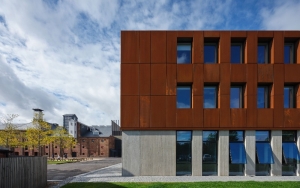
King's School Canterbury – International College
Eco-Friendly home for international students entering UK Boarding
A three-storey, cross-laminated timber building surrounding a courtyard, designed for international students. It features 34 ensuite bedrooms for 80 students, staff flats, and teaching facilities, primarily located on the ground floor, including classrooms, music rooms, IT suites, art studios, and common rooms. Achieved BREEAM 'Very Good'.
The project is part of the school’s £48m masterplan, which includes the Malthouse performing arts centre, Kingsdown House boarding accommodation, Mitchinson’s day house, and the new Rausing Science Centre—all developed in collaboration with Skelly & Couch.
The building features a modular, square plan, surrounding a private courtyard designed for socialising and outdoor learning. Ground floor classrooms are complemented by breakout spaces that overlook the courtyard. Above, the first and second floors accommodate up to 80 students in en-suite bedrooms, with staff flats provided on both levels.
The building has been designed on passive environmental principles. Early involvement ensured the façade and fenestrations allowed for all internal spaces to be adequately daylit, and naturally ventilated, while preventing overheating. Off-site construction bathroom pods and CLT elements have been integrated, requiring a high level of early co-ordination.
The ground floor classrooms are naturally ventilated, and include a system by Windowmaster, which monitors internal temperature and CO2 levels, adjusting window openings accordingly. The same classrooms rely on architecturally exposed concrete ceilings to provide thermal mass, maintaining comfortable internal temperatures all year round, without the need for active cooling measures.
LED lighting and smart lighting controls reduce electrical energy consumption. Underfloor heating has been used throughout the ground floor, utilising low water temperatures, thus reducing the heat demand from the main heating plant.
The International School creates a welcoming and inspiring experience for young pupils arriving in the UK, whilst setting a benchmark for sustainability in boarding education. It reinforces the school’s global leadership and environmental responsibility.
Awards
RIBA National Award 2021. Find out more.
Civic Trust Awards - Highly Commended. Judges’ Comments: “Overall, there is a good sense of proportions, the chosen materials work well and the atmosphere of the place is secure and safe for the student community.”

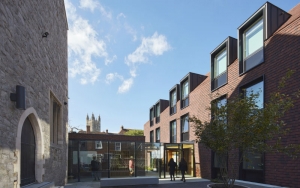
King’s School Canterbury – Kingsdown House
Heritage-Sensitive Phased Refurbishment and New Boarding Accommodation
Phase 1 involved the restoration and refurbishment of the Butterfield Building and Master’s House to create boarding accommodation for 30 pupils, including a common room, quiet study area, and kitchen. Phase 2 introduced a new building for older pupils, achieving a BREEAM 'Very Good' rating.
Located near Canterbury Cathedral, a Scheduled Ancient Monument, the Grade II-listed Butterfield Building, designed by William Butterfield in 1847, was sensitively upgraded and connected to a new boarding house for girls. The project was successfully executed on a rapid timeline, with the facilities required to be operational by the start of the academic year.
The refurbishment included new glazing and insulation to meet modern thermal standards, while the new building featured windows designed to optimise daylight and natural ventilation while minimising heat loss. The structure uses a recyclable steel frame combined with precast concrete planks and a concrete screed to balance thermal mass and lightweight construction, enhancing thermal capacity and reducing overheating.
Drainage was upgraded to HDPE, a more environmentally friendly option compared to PVC or cast iron.
Inefficient heating and lighting systems in the listed building were replaced, significantly reducing carbon emissions, while low-energy systems were implemented in the new building. LED lighting with 'absence control' was installed throughout to ensure lights automatically turn off when not in use. The heating system features automatic central controls, allowing sections of heating and hot water to be turned off when students are absent, while maintaining warmth in staff areas.
Kingsdown House blends modern functionality with heritage sensitivity. The project achieved a BREEAM 'Very Good' environmental rating, all while avoiding intrusive 'green' add-ons that could compromise its historic character.
Awards
2018 Civic Trust Awards – commendation
2017 RIBA South East Awards – shortlisted
2018 Canterbury Society Design Awards: New Building in a Conservation Area
2018 Canterbury Society Design Awards: Refurbishment
2018 Canterbury Society Design Awards: Overall Winner

New College Court, Emmanuel College
A phased transformation of the Emmanuel College Site around three new landscaped courts.
New residential student blocks with 59 ensuite rooms, gyms, fellow flats, and a 50-space subterranean car park, plus the transformation of a Grade II listed building to provide seminar, teaching, office, bar and event spaces along with the rebuilding of the South Court Social Hub.
The project was Emmanuel College’s most significant development for over 100 years and was located in the heart of the Cambridge Historic Core Conservation Area, in close proximity to the College’s historic Grade I and Grade II listed buildings. The aim was to redevelop a neglected part of the College site to create new facilities that enabled the College to meet its ambition to accommodate all undergraduate students on-site and for its community to mix, work and gather in new ways. Skelly & Couch were appointed as both M&E engineers and sustainability consultants and undertook full design duties using BIM.
From inception, Skelly & Couch worked closely with the architects to ensure the building massing and orientation was optimised to make best use of daylight and sunlight in all internal and external spaces. The advantages and disadvantages of concrete and CLT frames were considered and GGBS concrete frame with timber internal partitions and highly insulated timber facades was chosen for its improved performance in terms of summertime overheating and acoustics.
The system design included a number of energy and water saving measures such as mechanical ventilation and heat reclaim, rainwater recycling, Combined heat and power hot water heating, efficient LED lighting and controls. The strategy also included the implementation of an open loop ground source heat pump system that takes water from the underlying Lower Greensand Formation and provides heating and cooling to all of the buildings in the South of the College. It also includes an extensive 60kWp PV array on the South Court Building.
All of these measures represented an 80% operational carbon controls, low flow water fittings and a large Photovoltaic Array on the roof that powers the communal spaces.
Driven by a vision to cultivate an interconnected community, Emmanuel College adds a contemporary layer to its historic setting while enhancing social and intellectual life and prioritising sustainability for future relevance.
Press Coverage
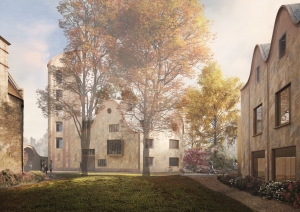
New College, Oxford
Student Living and Facilities Close to the Main College Site.
An ambitious scheme with 100 new student bedrooms (net gain of 74) and a subterranean events and music hall near the historic College. Built for longevity, it adopts a ‘less but better’ M&E approach, achieving 44% energy and 22% carbon savings, with a potential 20% offset from future PVs.
New College, one of Oxford’s largest and most architecturally distinctive colleges, has completed a major expansion with the Gradel Quad development, just four minutes’ walk from the main site. The project adds 100 student bedrooms (a net gain of 74) and introduces Oxford’s first underground concert hall, designed for events, exhibitions, and musical performance.
The development also includes the refurbishment of existing accommodation at Savill House, a Grade II listed building, two additional listed structures, and a neighbouring primary school, alongside the creation of a new porter’s lodge. Two south-facing garden quads form the heart of the site, designed to embrace sunlight and seasonal changes, foster a dynamic microclimate and a strong sense of place.
Built for a lifespan exceeding 100 years, the development reflects a long-term, sustainable vision. The construction process was designed to be waste-neutral with responsibly sourced materials and strong support to the local economy. The project also adopted a 'less but better' approach to building services which resulted in 44% energy savings and a 22% reduction in carbon emissions.
The design features a highly efficient thermal fabric and maximises daylight and ventilation. A timber roof structure replaced a concrete shell, reducing total primary energy use by over 50% and global warming potential by more than 20%. To future-proof the building, the design was tested against climate change scenarios and adapted to improve ventilation and thermal mass through thick clay plaster ceilings.
Efficient heating and hot water are provided by a 100 kW closed-loop ground source heat pump, thermal energy storage, and a micro combined heat and power unit. These are supported by smart building controls that optimising performance across systems. Rainwater recycling reduces demand on mains supply, and the roof is designed to accommodate future organic photovoltaic (PV) cells, with the potential to reduce carbon emissions by a further 20%.
Rooted in tradition and built for the future, the Gradel Quadrangles is a confident addition to New College. It combines low-carbon construction, long-term performance, and a strong sense of place, embodying a visionary approach to sustainable and meaningful academic place-making.
"David Kohn Architects’ sinuous Gradel Quadrangles at New College, Oxford, is one of the most significant recent additions to the historic cityscape, providing 94 student bedrooms, a shared study space and a performance auditorium and facilities for the Gradel Institute of Charity and the adjacent New College School. The judges applauded its 'meaningful' and'joyful' architecture. One judge commented: If you think of it as a piece of townscape, it has really pushed the boundaries. It's a really good response to its historic context." AJ Awards, 2025
Described by Historic England as ‘one of the few instances where contemporary design can be considered genuinely outstanding’.
Awards
2016 – World Architecture Festival shortlisted – Future Projects Education Category
2025 – Schüco Excellence Award Winner
2025 – Building Awards, Building Magazine Project of the Year, shortlisted
2025 – AJ Architecture Awards, Higher Education, Highly Commended
2025 – Prix Versailles Award, World’s Most Beautiful Campuses
2026 – Civic Trust Awards, Regional shortlisted
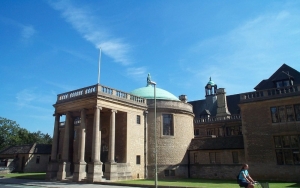
Rhodes House, Oxford
Skelly & Couch has completed Stage 4 design at the Grade II*-listed Rhodes House, Oxford, for a new world-class convening hub designed to encourage the global exchange of ideas across all cultures and nationalities.

Scape Greenwich Student Accommodation
A new student accommodation building at Greenwich Peninsula. Skelly & Couch was appointed to provide full mechanical, electrical, public health and environmental services for the client on this design and build.